REVIEW · TIRANA
The truest face of Communism
Book on Viator →Operated by Lost In Albania · Bookable on Viator
Tirana’s past is still written in concrete. This private tour packs the major communist landmarks into a half-day walk-and-stop format, with coffee and rakija to keep the conversation going. It’s built around the story of Enver Hoxha’s regime and the isolation that shaped daily life, not just monuments for photos.
I really like that it feels personal (you’re with your own group) and that the stops are connected thematically, so you understand why each site exists. The other big plus: admissions for the key sites are either free or included, which makes the value feel honest for a $90.11 price tag. One drawback to consider: it’s presented as a tour with an air-conditioned vehicle, but expect plenty of moving around on foot, so wear comfortable shoes and plan for a history-heavy day.
In This Review
- Key things I’d circle before you go
- Turning Tirana into a history lesson (without the museum fatigue)
- Price and what you really get for $90.11
- Stop-by-stop: the communist story told in five scenes
- Stop 1: Skanderbeg Square and the power architecture around it
- Stop 2: The Enver Hoxha Pyramid—propaganda turned into a tourist stop
- Stop 3: Postbllok—how isolation was built into everyday fear
- Stop 4: Blloku—luxury for the few, rebellion for the story
- Stop 5: Bunk’Art 1—underground shelter and the cold logic of protection
- A note on the walking reality
- Coffee, rakija, and why the guide matters
- What kind of traveler should book this?
- Should you book the Truest Face of Communism tour?
- FAQ
- FAQ
- How long is the tour?
- What time does it start, and where do we meet?
- Do you get hotel pickup?
- Is the tour private?
- What’s included in the price?
- Is lunch included?
- Are entrance fees included?
- Is the tour offered in English?
- Can I cancel and get a full refund?
Key things I’d circle before you go
- A private group means you get the pace you want (and fewer stress moments).
- Communism in layers: Hoxha-era symbols up top, plus real underground shelter spaces below.
- Coffee and rakija are included, so you get local flavor without doing extra planning.
- Admission is mostly handled: major stops are free or included.
- Guides like Leo, Dio, Mimi, DC, Aldo, and Eni are repeatedly praised for clear English and story-driven explanations.
Turning Tirana into a history lesson (without the museum fatigue)
If you think Albania’s communist era is only for textbooks, this tour changes your mind fast. Tirana doesn’t keep that period in the past. It keeps it in buildings you can still point to: the Pyramid, the bunker memorial spaces, and the neighborhood that shows how power distorted everyday life.
What makes the experience work is the sequencing. You don’t jump randomly from one site to another. You start at the city’s core, then move into the symbols and scars of the regime. By the time you reach the underground world of Bunk’Art 1, the earlier stops click into place.
And it’s not just “look at this structure.” You also get the human angle. A theme that keeps showing up with the guides on this tour is family-level context—what it meant for real people when Albania went its own strict, isolated way under Hoxha.
You can also read our reviews of more tours and experiences in Tirana.
Price and what you really get for $90.11
At $90.11 per person, this tour isn’t the cheapest thing in Tirana—but it also isn’t trying to be. For the money, you’re paying for:
- Hotel pickup (from your chosen place in Tirana, arranged ahead of time)
- An air-conditioned vehicle for parts of the route
- All fees and taxes
- Coffee and/or tea
- Alcoholic beverages (rakija is part of the included experience)
- Admissions that are free or included depending on the stop
The practical value here is that the day is built to reduce friction. You’re not coordinating tickets at each site or scrambling for a meeting place beyond Skanderbeg Square. You also get a structure that covers the major “communism face” sights in one go—useful if your time in Tirana is tight.
If you’re traveling with a small group, the private format also helps the money feel more fair. A group of friends or a family setup turns “$90 each” into a day you can actually manage, rather than a rushed checklist.
Stop-by-stop: the communist story told in five scenes
This is a 4 to 5 hour tour that starts at 9:00am back at Sheshi Skënderbej, Tiranë, Albania. Pickup is offered from where you’re staying, and the tour finishes back near the start.
Here’s how the day reads as you move through it.
Stop 1: Skanderbeg Square and the power architecture around it
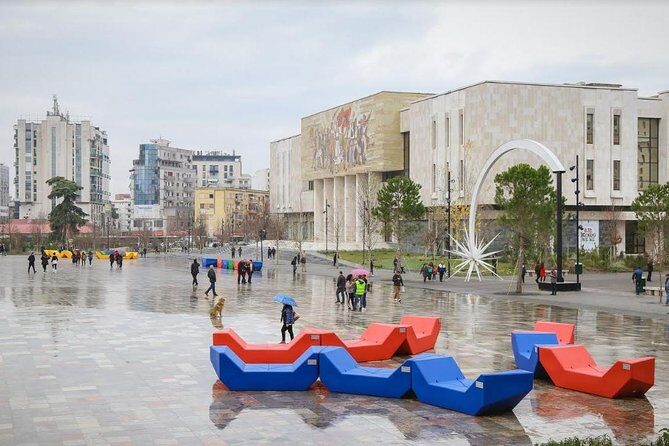
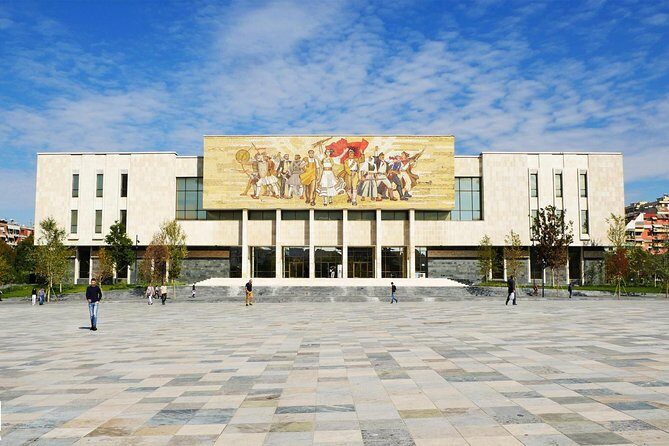
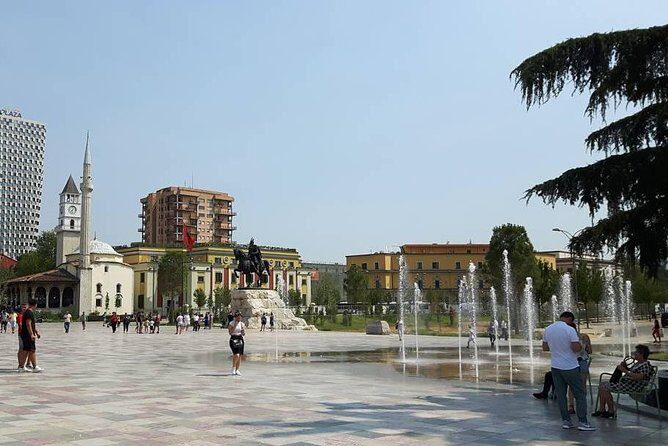
You begin in Skanderbeg Square, the kind of place where the city shows off its “official face.” Expect sights like the Et’hem Bey Mosque, the Clock Tower, the National Theater of Opera and Ballet, and the National Bank of Albania. You’ll also pass major hotels tied to Tirana’s identity, including the Tirana International Hotel and the older iconic hotel nearby.
One detail I think you’ll enjoy: the National Theater’s first brick was put in by Nikita Khrushchev, former President of the Soviet Union. It’s a small moment that signals a big point—Albania wasn’t floating in history’s bubble. Even when it later turned inward, the region’s communist connections were real and shifting.
This stop is mostly about orientation. It sets the stage so the later regime symbols don’t feel randomly placed.
Stop 2: The Enver Hoxha Pyramid—propaganda turned into a tourist stop
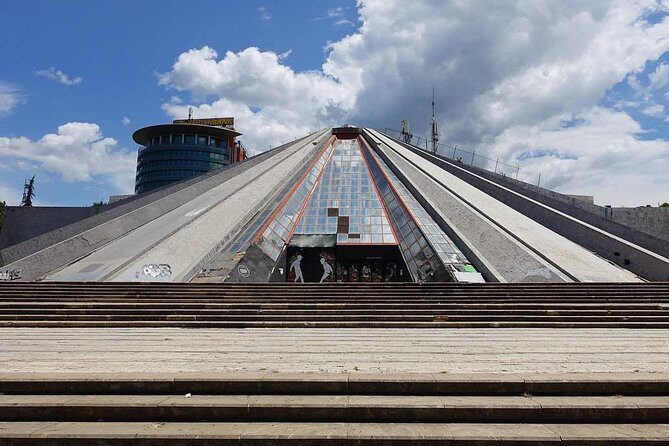
Then you reach one of Tirana’s most recognizable communist leftovers: the Enver Hoxha Pyramid. It sits on the main boulevard like a blunt sign, built as a museum dedicated to Hoxha (leader of the Communist Party, First Secretary of the Party of Labor from 1944 to 1985, and central figure in Albania’s harsh communist system).
Here’s what’s useful to know before you arrive:
- It was designed to remember the man and the regime
- The mausoleum opened later (in 1988)
- After communism fell, the building shifted roles—served as a cultural center and even as a National Television office
It’s still standing, and the tour framing makes its survival part of the message. You’re not just looking at architecture; you’re seeing how countries handle memory when the ideology that built the structure becomes unacceptable.
Admission here is listed as free, so it’s one of those stops that costs you nothing extra but pays off in understanding.
Stop 3: Postbllok—how isolation was built into everyday fear
Next is Postbllok – Checkpoint Monument, a memorial to communist isolation and control. It’s built by former regime dissident Fatos Lubonja and artist Ardian Isufi, and it’s composed of three linked elements:
- A concrete defensive bunker concept (the dictatorship built thousands of these—one for each family, in case of nuclear/world war)
- Concrete supports from the Spaç labor camp (where political prisoners suffered between 1968 and 1990)
- A brightly painted section from the Berlin Wall theme—connecting the idea of splitting societies in two
Even if you’ve read about these places, seeing them braided together changes the impact. It turns “history” into a built environment where fear and control are physically represented.
This stop is short (about 10 minutes) and admission is free, but it’s one of those moments that makes you slow down.
Stop 4: Blloku—luxury for the few, rebellion for the story
Now you shift from memorial and propaganda into the neighborhood that shows how power lived. Blloku used to be the leisure area for the communist political bureau—an area reportedly even missed on some maps. Today it’s one of the centers of Tirana life, with boutiques, coffee shops, cocktail bars, and street art.
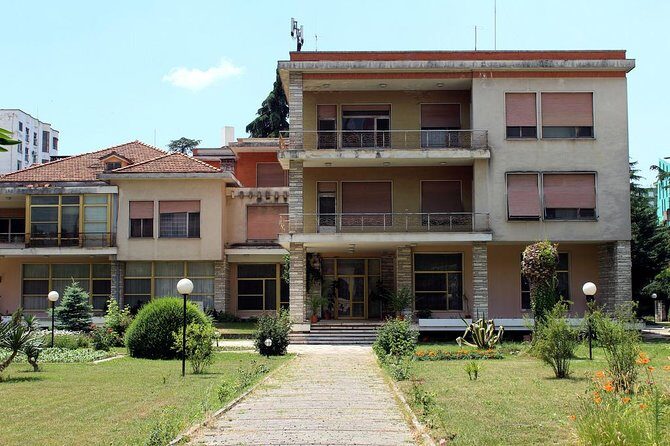
You’ll also see the former villa of Hoxha. Important detail: you can only view it from the outside because entry isn’t allowed. That restriction actually makes sense in the symbolism of the day—some places remain frozen in status.
Food and drink are part of this segment. The tour includes a short stop near the area where you can try traditional food and rakija. Even if you’re not a big alcohol person, this is a real-cultural moment rather than a quick “toast and move on.”
Admission for this stop is included, and you’ll spend around 50 minutes here.
One more thing to keep in mind: Blloku can feel like a normal city neighborhood in the present day. That’s part of the point. The contrast forces the question: how do you live inside a system that separates luxury and suffering so sharply?
Stop 5: Bunk’Art 1—underground shelter and the cold logic of protection
The last big stop is Bunk’Art 1, one of the most compelling parts of the entire day. The museum is underground—an almost 3,000 m² maze of rooms, corridors, and container-like spaces spread over several floors. It was built in the 1970s, stayed secret for a long time, and was designed to survive nuclear attacks.
What I love about this stop as an experience type is that it forces your body to understand the story. You’re not just seeing labels. You’re walking through the kind of construction meant to compress human lives into survival geometry. The description even notes the space could host more than 100 people, which makes it clear this wasn’t meant for one person’s escape—it was built for mass, controlled endurance.
The museum also connects back to the earlier stops. That idea of isolation and fear stops being abstract when you see the bunker walls, the tight planning, and the scale.
Admission is included, and the stop runs about 1 hour—enough time to take it in without feeling rushed.
A note on the walking reality
On paper, the tour includes an air-conditioned vehicle. In practice, a day like this often becomes “walk between statements” in a central-city route. Plan as if you’ll be on your feet more than you’d expect, and bring comfortable shoes. If you’re sensitive to long standing (especially indoors in underground spaces), you might want breaks during the Bunk’Art portion.
Coffee, rakija, and why the guide matters
This is not a “read it off the wall” kind of tour. The structure relies on your guide’s ability to connect dots and make the regime’s decisions make sense.
The guides you’ll hear named include Leo, Dio, Mimi, DC, Aldo, and Eni. The praise pattern is consistent: clear English, careful attention, and story-based explanation. Guides also bring personal perspective—like how a family experienced the period—which helps you avoid turning the whole day into a political lecture.
And yes, the included drinks matter here:
- Coffee and/or tea gives you a civilized rhythm break.
- Alcoholic beverages (rakija) show up as part of the included experience at the Blloku-area stop.
Just keep it practical. Rakija can be stronger than you expect, so pace it. You’ll want to be fully present for the bunker rooms and the memorial sections.
What kind of traveler should book this?
This is ideal if you:
- Want a focused Tirana day instead of wandering
- Like history, especially the “how did it feel” side of history
- Appreciate guided context more than self-guided signage
You might want to choose something lighter if:
- You don’t want a day heavy on political suffering and detention themes
- You’re not comfortable with underground spaces (Bunk’Art is a multi-floor underground museum)
- You’re hoping for long restaurant time—lunch is not included, so you’ll need to plan for that after the tour
The tour does include a short traditional food stop near Blloku, but it’s not the same as a full lunch.
Should you book the Truest Face of Communism tour?
I’d book it if your goal is understanding Tirana’s layers fast and you’re okay with a serious theme. For $90.11, you’re not just buying entry tickets—you’re buying interpretation: a guide who can connect monuments, memorials, and daily-life contrasts into one narrative. The private format also makes it smoother, especially if you’re traveling with friends or want questions answered in real time.
If you want a relaxed, postcard-only Tirana day, this probably won’t match your mood. But if you want the “why” behind the Pyramid, the bunker memorials, and the contrast of Blloku’s past and present, this tour gives you a clear path.
FAQ
FAQ
How long is the tour?
It runs about 4 to 5 hours.
What time does it start, and where do we meet?
It starts at 9:00am at Skanderbeg Square (Sheshi Skënderbej, Tiranë, Albania). The tour ends back at the meeting point.
Do you get hotel pickup?
Yes. Hotel pickup is included, and pickup is offered from your chosen place of staying in Tirana (arranged before the trip).
Is the tour private?
Yes. It’s a private tour/activity, meaning only your group participates.
What’s included in the price?
Included are an air-conditioned vehicle, all fees and taxes, coffee and/or tea, alcoholic beverages (rakija is mentioned as part of the experience), and hotel pickup.
Is lunch included?
No. Lunch is not included.
Are entrance fees included?
For major stops: Skanderbeg Square and Enver Hoxha Pyramid and Postbllok list admission free, while Blloku and Bunk’Art 1 list admission as included.
Is the tour offered in English?
Yes. It’s offered in English.
Can I cancel and get a full refund?
Yes. You can cancel for a full refund up to 24 hours in advance. If weather makes the tour unsuitable, you’ll be offered a different date or a full refund.