REVIEW · TIRANA
Tirana Walking Tour around the Historic Centre
Book on Viator →Operated by Local Walking Tours of Tirana · Bookable on Viator
Tirana stories come at walking speed. This 2.5-hour historic-centre tour stitches together monuments, places of worship, and Communist-era landmarks with photo stops and mostly free entry. You’ll get a guided way to read Tirana instead of just passing through it.
I like the certified guides and the interactive style that keeps the walk moving without feeling rushed. I also like that the tour includes access to churches and mosques, so you’re not stuck outside looking in.
One possible drawback: the schedule is sight-heavy. If you crave long indoor time at a single museum, this tour will feel like a fast sampler.
In This Review
- Key highlights you’ll feel on the ground
- From National Museum to Skanderbeg Square: the centre’s big story, on foot
- Et’hem Bey Mosque and the Clock Tower: religion and everyday details
- The Cloud art installation and Bunk’Art 2: modern Tirana meets memory
- Murat Toptani to Tirana Castle: old roads and a walkable city core
- St. Paul Cathedral and the Resurrection Cathedral: two faiths, both human-sized
- Enver Hoxha Pyramid and the boulevard of power: dictatorship explained in plain terms
- Blloku and Youth Park to House of Leaves: the calmer ending with real questions
- Price and logistics: why $18.06 can actually feel fair
- Should you book this Tirana historic-centre walk?
- FAQ
- How long is the Tirana Walking Tour around the Historic Centre?
- How much does the tour cost?
- Is the tour offered in English?
- Do I need to buy tickets for the stops?
- Where is the meeting point?
- Where does the tour end?
- Do I get a mobile ticket?
- How big is the group?
Key highlights you’ll feel on the ground
- Small-group format (max 20): easier questions, tighter pacing, and fewer lost moments.
- Skanderbeg Square focus: the heart of Tirana’s public identity, with the monument that anchors the whole centre.
- Real interior visits: you’ll go inside the Et’hem Bey Mosque and the Resurrection Cathedral.
- Communist-era symbols with context: the Enver Hoxha Pyramid and other heavy sites are explained in plain language.
- Photo-worthy “Tirana Castle” and viewpoints: enough time to enjoy the feel of the old city fabric.
- Smart ending near House of Leaves: you can finish your walk and then step into the museum right after.
From National Museum to Skanderbeg Square: the centre’s big story, on foot
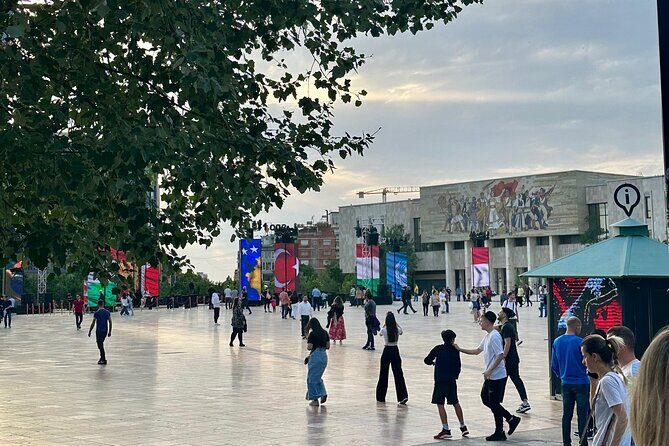
This tour is built around one useful idea: Tirana is best understood as layers. The walk starts with the National History Museum (Muzeu Historik Kombetar), which sets the tone with a massive mural mosaic above the entrance called The Albanians. Even before you step fully into the story of modern Tirana, you’re looking at how the city frames national identity.
Then you shift into the open-air core: Skanderbeg Square. This is where you feel the scale of the centre. The square is named after Albania’s national hero, Gjergj Kastrioti Skënderbeu, and the monument dominates the space. What I like here is how the walk makes the square feel more than a landmark. You’re taught what it represents in everyday city life—where people gather, where the public center flexes its identity.
A few steps away, you’ll pause at the National Theatre of Opera and Ballet of Albania. It’s the largest theatre in the country and it hosts music and dance year-round. Even if you’re not catching a performance, this stop is a good reminder that Tirana isn’t only monuments. Culture here is also a living calendar, not just a photo backdrop.
Right after that, you circle back to the Skanderbeg Monument itself again for a more deliberate look. The second pass matters. At first it’s just a statue and a square. On the walk, it becomes a way to understand the city’s public “map” of importance—who gets honored, and how the centre wants you to see the nation.
Practical tip: Bring a phone camera strap or something secure. This area is windy sometimes and you’ll be stopping for monument photos more than once.
You can also read our reviews of more walking tours in Tirana
Et’hem Bey Mosque and the Clock Tower: religion and everyday details
Next comes one of the most rewarding parts of the route: Et’hem Bey Mosque (Xhamia Et’hem Bej). It reopened as a house of worship in 1991 after being closed under communist rule, and the tour focuses on why that reopening matters. You’ll see frescoes inside and outside the portico that depict trees, waterfalls, and bridges. Those images are not just decoration—they’re a mood. They help you understand that worship spaces often carry storytelling, not only rituals.
I also like that you visit inside. Many walking tours treat mosques as exterior photo stops. Here, you get a more authentic sense of how the building holds light and meaning. If you’re visiting Tirana for the first time, this stop also works as a “context reset.” It turns your attention from political monuments to lived spaces.
A short step later, you hit the Clock Tower. Built in 1822 by Et’hem bey Mollaj, it’s tied to the same cultural circle that shaped the area, including the poet and craftsman tradition around the mosque. The tour points out the clock mechanism assembly by Ismail Tufina in 1822. This is the kind of detail that makes you notice the city’s everyday engineering—how timekeeping and public structures shaped daily rhythm.
Possible drawback to consider: This section can feel a little “stop-start” if you’re the type who hates short photo pauses. The upside is you get the important moments without needing to time a ticket line.
The Cloud art installation and Bunk’Art 2: modern Tirana meets memory
Then the walk turns contemporary, and it’s a welcome change of pace. The Cloud (Reja) is an art installation in front of the National Gallery of Arts. Designed by Japanese architect Sou Fujimoto, it began serving as a modern art space in 2016 and hosts cultural events. The structure is delicate and three-dimensional, so it’s interesting not only from the front but also as you walk around it. It’s a small pause that helps you breathe between heavy history stops.
Right after that, you shift into one of Tirana’s most direct memory projects: Bunk’Art 2. This is a re-imagining of a Communist-era nuclear bunker turned museum and art space. The tour includes an outside visit, which still gives you a strong sense of place—how the city repurposes fear and secrecy into something you can approach with questions.
What I like about pairing these stops is contrast. You see modern cultural expression (The Cloud), then you see the physical architecture of the old regime (Bunk’Art 2). Together they teach a key lesson: Tirana isn’t pretending the past vanished. It reworks it.
Practical tip: If you’re sensitive to dark themes, take your time here. The tour doesn’t linger as long as a full museum visit might, but you’ll still get enough context to choose how you want to process it.
Murat Toptani to Tirana Castle: old roads and a walkable city core
At this point, the tour starts to feel more like wandering through real city texture. Murat Toptani Road is a pedestrian street named for the Toptani family, a leading Albanian noble family during Ottoman rule. This is the kind of street where you can look at storefront life, street energy, and the way the centre has been designed for walking.
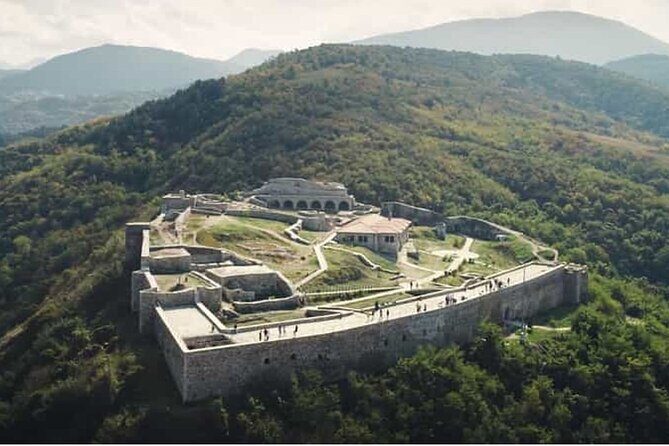
Then you reach the Fortress of Justinian, often called Tirana Castle. Its history dates back before 1300, with Byzantine-era roots. The important idea here isn’t only the stones—it’s that the fortress marks where major east–west and north–south roads crossed. In other words, this is literally where the city’s movement once concentrated.
You can explore inside the fortified walls, where buildings include restaurants, hotels, and cultural institutions. The time here is short, but it’s enough to get the feel: a historic “contained world” inside the larger city. It’s also a nice switch from the square-and-monument rhythm. Instead of standing in one place, you move through layers of space.
Consideration: The stop is brief. If you want a long, quiet exploration, plan to return on your own later.
St. Paul Cathedral and the Resurrection Cathedral: two faiths, both human-sized
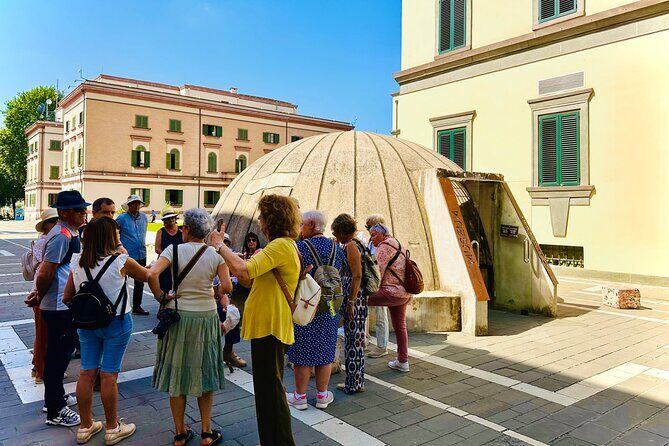
Now the tour balances official national landmarks with more intimate interior moments. First is St. Paul Cathedral. The building is modern-looking and doesn’t match a classic traditional church shape. What helps you understand it is the stained glass window featuring Pope John Paul II and Mother Teresa. There’s also a statue of Mother Teresa near the entrance.
You’re not just seeing a facade here. The tour’s emphasis is on understanding how faith is expressed through design choices in modern Tirana. Even if the architecture isn’t what you expect from a European cathedral, the symbolism and iconography give the stop weight.
Then you move to the Orthodox Autocephalous Church of Albania, the Resurrection Cathedral. It’s considered among the largest Eastern Orthodox churches in the Balkans. Here, you’ll visit from inside. That inside access is huge for getting past the exterior assumptions and understanding scale, light, and how the interior carries the community’s presence.
Why this section matters: Tirana’s centre is often discussed in political terms. These church stops shift you back into human scale. They remind you that the city’s identity isn’t only top-down monuments. It’s also daily worship spaces.
You can also read our reviews of more historical tours in Tirana



Enver Hoxha Pyramid and the boulevard of power: dictatorship explained in plain terms
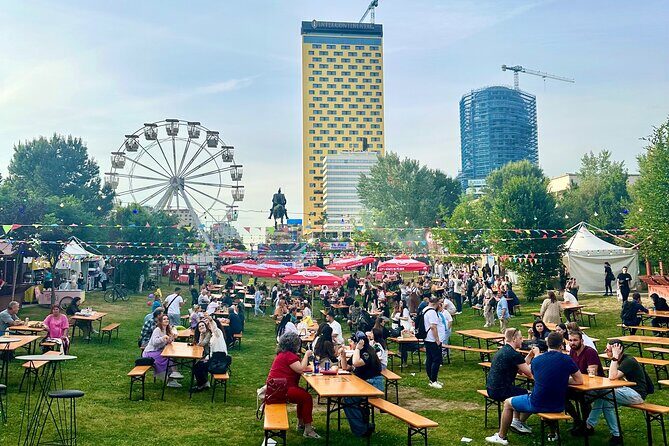
This is the heaviest stretch of the walk, and it’s handled in an easy-to-follow way. The Enver Hoxha Pyramid is a structure and former museum of the dictator Enver Hoxha. It opened as a museum in 1988, then changed use in 1991 after the collapse of Communism. During the Kosovo War, the building served as a NATO base. Later, the plan became a youth IT center, and the renovated structure reopened to the public in May 2023.
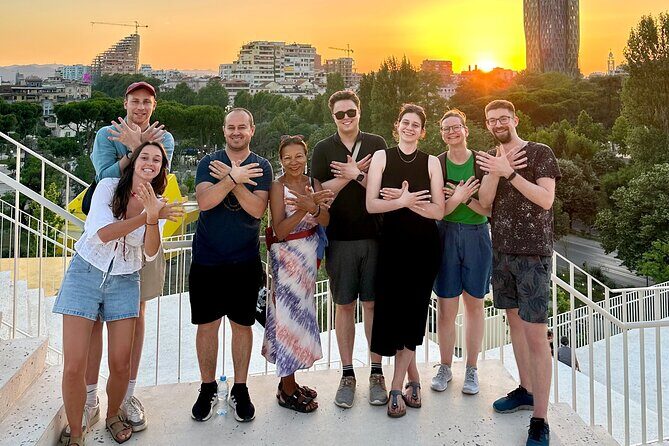
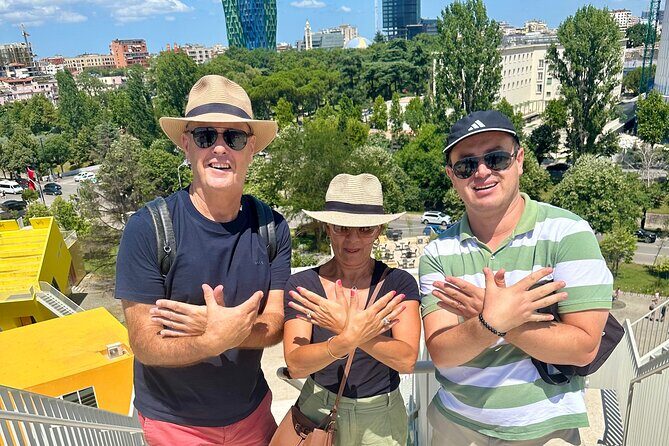
A big included bonus here: you can climb up to the top of the pyramid for breathtaking views, with a sunset photo stop. Even if you don’t catch a perfect sunset, climbing helps you connect the place to the city around it. You stop being only a spectator. You become a reader of the skyline.
From there, you walk along Dëshmorët e Kombit Boulevard, the Boulevard of the Martyrs of the Nation. Along this main thoroughfare you’ll pass buildings tied to national leadership and big institutions: the Presidential Palace, Prime Minister’s Office, Palace of Congress, Rogner Hotel, and the University of Tirana. It’s a useful “power corridor” to see with your own feet, even if you only get exterior looks.
Practical tip: If you’re planning photos on the pyramid top, keep your hands free. The climb is part of the experience, not an optional afterthought.
Blloku and Youth Park to House of Leaves: the calmer ending with real questions
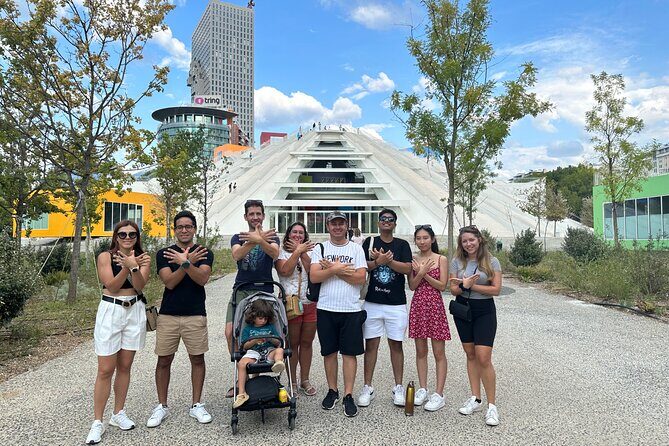
After the political center, the walk turns toward how Tirana lives now. Blloku is the most famous neighbourhood in the city. It’s leafy and residential, but it’s also an upscale nightlife and shopping hotspot with hip bars and cafes and trendy global restaurants alongside luxury boutiques.
What makes Blloku more than a “where to eat” stop is its communist past. During the communist era, it was a closed-off precinct for party elite, and Enver Hoxha’s villa still stands. So you’re seeing a neighbourhood that has transformed, but it hasn’t erased what it used to be.
Then you reach Rinia Park, Youth Park. It was built in 1950 during the communist era and covers about 2.98 hectares. It’s also called Taiwan Park. This is a smart break after intensity: a central public green space where you can reset your eyes and let the day breathe. Even if you’re not a park person, it gives you a moment to reflect on the jump from monuments and power to ordinary leisure.
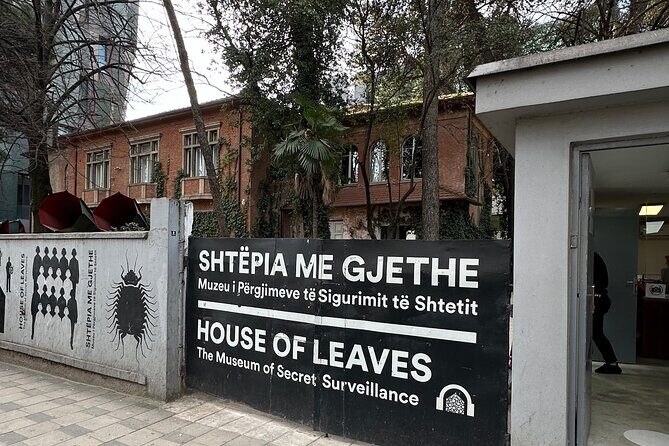
From there, the route finishes with the Museum of Secret Surveillance, also known as House of Leaves. The museum opened in 2017 in a building that served as the Sigurimi’s headquarters during the communist era. The tour includes an outside visit, and it’s an especially good ending point because it says you’re best positioned to enter the museum right after the walk.
That closing choice is practical: you finish near the exact place you may want to spend extra time. Even if the museum content is emotionally intense, having it at the end helps you decide what you can handle after your guided context.
Consideration: The walking pace stays active. If you like sitting down often, you might add short coffee breaks in Blloku or near Youth Park.
Price and logistics: why $18.06 can actually feel fair
At about $18.06 per person for roughly 2 hours 30 minutes, this tour can feel like solid value because so many stops are free or include key access. The tour also includes entrance to churches and mosques, plus a guided flow with photo stops at monuments. On a walking tour, that kind of inclusion matters. It cuts down your mental load and makes it easier to plan a day without surprise ticket hassles.
You’re also getting a group cap of 20, which is a sweet spot for a walking experience. Big groups often create delays and missed commentary. Here, the format suggests you’ll have room to ask questions and keep moving.
The only real “logistics” thing to plan around is simply comfort: wear shoes you can trust. This is a historic-centre route with many short pauses. You’ll be standing at least as much as you’re walking.
Should you book this Tirana historic-centre walk?
I’d book it if you want a first-pass guide to Tirana that mixes monuments, places of worship, and Communist-era sites without making you piece it all together on your own. It’s especially good for visitors who like context and don’t mind moving often between stops.
I’d skip or adjust expectations if you know you want deep museum time at one location. This walk is designed to show you the big picture and then point you toward where to go next—especially at the end near House of Leaves.
If you’re trying to do the “best of the centre” in one outing, this is a smart pick. It’s long enough to feel like a real experience, and structured enough that Tirana stops being a blur.
FAQ
How long is the Tirana Walking Tour around the Historic Centre?
It lasts about 2 hours 30 minutes.
How much does the tour cost?
The price is $18.06 per person.
Is the tour offered in English?
Yes, it’s offered in English.
Do I need to buy tickets for the stops?
Many stops are free, and the tour includes entrance to churches and mosques.
Where is the meeting point?
The start is at Karuseli8RH9+42R, Tiranë, Albania.
Where does the tour end?
It ends at House of Leaves Museum, Rruga Ibrahim Rugova 12, Tiranë 1001, Albania.
Do I get a mobile ticket?
Yes, it’s a mobile ticket.
How big is the group?
The maximum group size is 20 travelers.