REVIEW · TIRANA
Durrës: Walking tour with Roman Amphitheater
Book on Viator →Operated by My Tour in Albania · Bookable on Viator
If you want a history moment that doesn’t eat your whole day, this works. You’ll head to the Roman Amphitheater in Durres with a guide who explains what you’re looking at, and you get the entrance ticket included in the price. It’s also a short visit at about 30 minutes at the site, which keeps the pace realistic.
Two things I like about this setup: the amphitheater access is straightforward, and the tour is built around a small group size (up to 15), so it doesn’t feel like a lecture in a crowd. One thing to think about: the site’s condition and signage can be uneven, and the amphitheater’s scale may feel less dramatic in person than in your head.
In This Review
- Key points before you go
- Why the Durres Amphitheater is worth your time
- Price and what $40.65 really buys you
- Meeting at Sheshi Liria: how the walk fits your day
- Stop 1: Durres Amphitheatre—what to look for in 30 minutes
- What the guide adds (and where you might feel limited)
- Weather matters: plan around the “good weather required” note
- Who this tour suits best
- Should you book the Durres Amphitheatre walking tour?
- FAQ
- How much does the Durrës Roman Amphitheater walking tour cost?
- How long is the tour?
- Where do I meet the guide?
- Is the entrance ticket included?
- Do I get a mobile ticket?
- What are the group size limits?
- What happens if the weather is bad or I need to cancel?
Key points before you go
- Small group size (max 15): easier questions, better attention.
- Entrance ticket included: you’re not juggling extra costs at the gate.
- Mobile ticket: you can keep everything on your phone.
- 30 minutes at the amphitheater: enough time to orient yourself without rushing.
- Good weather required: plan for the possibility of a schedule change.
- Minimum of 2 travelers: if the group is small, dates may adjust.
Why the Durres Amphitheater is worth your time

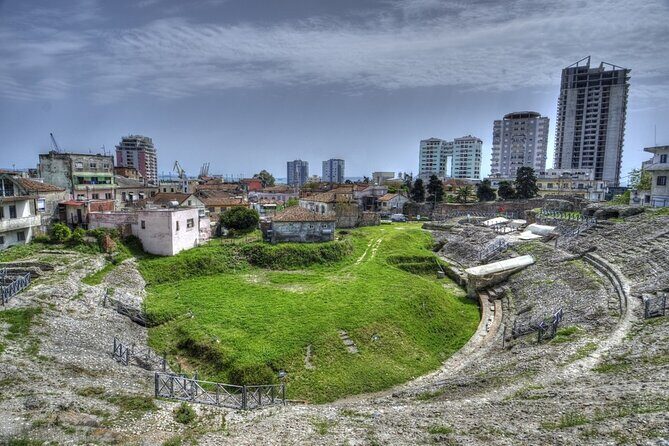
Durres is one of those Albanian stops where you can mix street-life with real Roman bones, and this tour leans into that. The amphitheater is tied to major Roman ambition, and the story you’ll hear helps you look past “just old stones.”
One of the most interesting details you may pick up is the connection to Emperor Trajan. You’ll hear that in the 2nd century, Trajan oversaw construction that became the big amphitheater idea in the region, with a capacity often cited around 20,000 people. After that, the story shifts—its glory is described as fading around 350 AD, with a violent earthquake playing a role in how the site ended up the way it is today.
That context matters. When you know why the place was built and how it changed, you can judge what you’re seeing with more fairness. Even if you’re not the type who loves ruins for their own sake, the explanation gives you a reason to look carefully.
You can also read our reviews of more walking tours in Tirana


Price and what $40.65 really buys you

At $40.65 per person, the headline price is simple—but the value depends on what’s included. Here, your money covers a guide plus the entrance ticket for the Roman Amphitheater. That’s important because amphitheater sites can add a separate ticket cost later, and you’re not doing that math while standing there.
The tour timing also helps the value. You’re booked for about 1 hour 30 minutes, but the amphitheater time itself is about 30 minutes. That’s a good trade if you want history without turning the day into a long museum marathon.
Still, set expectations. Some people find the amphitheater less imposing than they hoped, partly because a large portion is still underground and the site condition isn’t perfect. In other words: you’re paying for guidance and entry, not for a fully polished “wow” experience.
Meeting at Sheshi Liria: how the walk fits your day
You meet at Sheshi Liria, Durrës, and you finish at the same place. That means less hassle and less guessing where the tour ends—handy if you plan to grab lunch afterward or continue sightseeing on your own.
The tour is described as near public transportation, so you’re not forced into a complicated logistics puzzle. It’s also listed as something that most travelers can participate in, which suggests it’s not built around extreme steps or long endurance segments.
Group size is another practical point. The tour caps at 15 travelers, and it has a minimum requirement of 2 people. That mix usually helps with flow: you get a guided pace, but it’s not so large that you can’t hear what the guide is saying when you stop.
Stop 1: Durres Amphitheatre—what to look for in 30 minutes
Most of your “site time” is at the amphitheater itself, with about 30 minutes on location. That short window is ideal if you use it smartly: don’t try to read everything, scan what’s there, and let the guide’s explanation point you to the right features.
Here’s what you may want to focus on:
- Scale cues: even if you feel it’s not “huge” in person, try to compare it to the idea of what it held when it was functioning.
- What’s missing: one review notes that illustrative inscriptions are missing, which can limit how much you can self-narrate from signage alone.
- The underground reality: another comment points out that a big part of the amphitheater lies beneath the ground, so you may see less than the name might imply.
- Construction story: the Trajan-era origin and the later decline around the mid-4th century are key to making sense of what you see now.
It’s also worth adjusting your “impressiveness” standard. If you’re expecting a perfectly preserved, towering, photo-ready arena, you might feel underwhelmed. If you’re okay with “archaeology you can sense,” plus a guide’s context, you’ll likely get more out of it.
Accessibility is generally a plus. One comment calls it easily accessible, so you should be able to reach the main viewing area without a major ordeal. Just keep in mind that ease doesn’t always mean comfort—old outdoor stone sites can be uneven.
What the guide adds (and where you might feel limited)

A local guide is included, and in a site like this, that can make the difference between walking past ruins and actually understanding them. The value isn’t in fancy production—it’s in the order of the story: why it was built, who pushed it forward, and how events changed its fate.
Based on the themes in the feedback, the guide’s explanations are where you’ll likely feel the “worth it” factor. When signage is incomplete or inscriptions are missing, you lose some self-guided interpretation. A guide helps you bridge that gap by pointing out what those missing elements were meant to communicate.
At the same time, don’t pretend the amphitheater is a complete, polished package. One comment says the site isn’t kept up very well. Another frames it as not your cup of tea if you want a stronger impact. That’s a fair warning: you’re not guaranteed a perfectly curated experience.
My practical advice: treat this as a compact history walk. If you want a deep, museum-style experience with lots of restored detail, this won’t be that. If you want an efficient, human-scale introduction to Durres Roman remains, it fits.






Weather matters: plan around the “good weather required” note
This experience is weather-dependent. It requires good weather, and if it’s canceled due to poor conditions, you’ll be offered a different date or a full refund.
That has a real travel impact. If your schedule is tight—only one day in Durres, fixed flight times—you’ll want to keep your amphitheater tour flexible. If your trip has buffer time, you can let weather do what weather does and still land the visit.
Also, remember this is mostly an outdoor stop. Even if the amphitheater time is only about 30 minutes, the walk and orientation still happen outside.
Who this tour suits best
This tour is a solid fit if you like history that doesn’t bulldoze your day. The duration is short, the group is small, and the site is reachable from a central meeting point.
It’s also a good match for you if:
- You’re visiting Durres and want one focused Roman stop.
- You prefer guided context over wandering with guesswork.
- You’d rather spend an hour and a half with a guide than two-plus hours searching the site alone.
It may be less ideal if you’re chasing a “big wow” ruin. Because a lot of the amphitheater is still underground and the site upkeep can be spotty, your expectations need to be in the right place. Think: authentic and a bit rough around the edges, not “Instagram-perfect.”
Should you book the Durres Amphitheatre walking tour?
I’d book it if you want a quick, guided look at a Roman site with real narrative payoff—especially since the guide and entrance ticket are included and the group stays small. For the price, you’re buying structure: where to look and what the place meant, not just access to a fenced-off area.
Skip it or book with softer expectations if you strongly prefer highly restored landmarks, perfect signage, and dramatic in-person scale. This amphitheater can feel underwhelming if your idea of Roman grandeur is based on fully visible, thoroughly maintained monuments.
If you’re sitting on the fence, my vote is to go—on a day when weather cooperates—because the time is short, the entry is handled, and the historical context is exactly what makes a site like this click.
FAQ
How much does the Durrës Roman Amphitheater walking tour cost?
The price is $40.65 per person.
How long is the tour?
The duration is about 1 hour 30 minutes.
Where do I meet the guide?
You start at Sheshi Liria, Durrës, Albania, and you also finish there.
Is the entrance ticket included?
Yes. The entrance ticket for the Roman Amphitheater is included.
Do I get a mobile ticket?
Yes. The tour uses a mobile ticket.
What are the group size limits?
The tour has a maximum of 15 travelers, and it requires a minimum of 2 persons to run.
What happens if the weather is bad or I need to cancel?
Good weather is required. If it’s canceled due to poor weather, you’ll be offered a different date or a full refund. You can cancel up to 24 hours in advance for a full refund.